
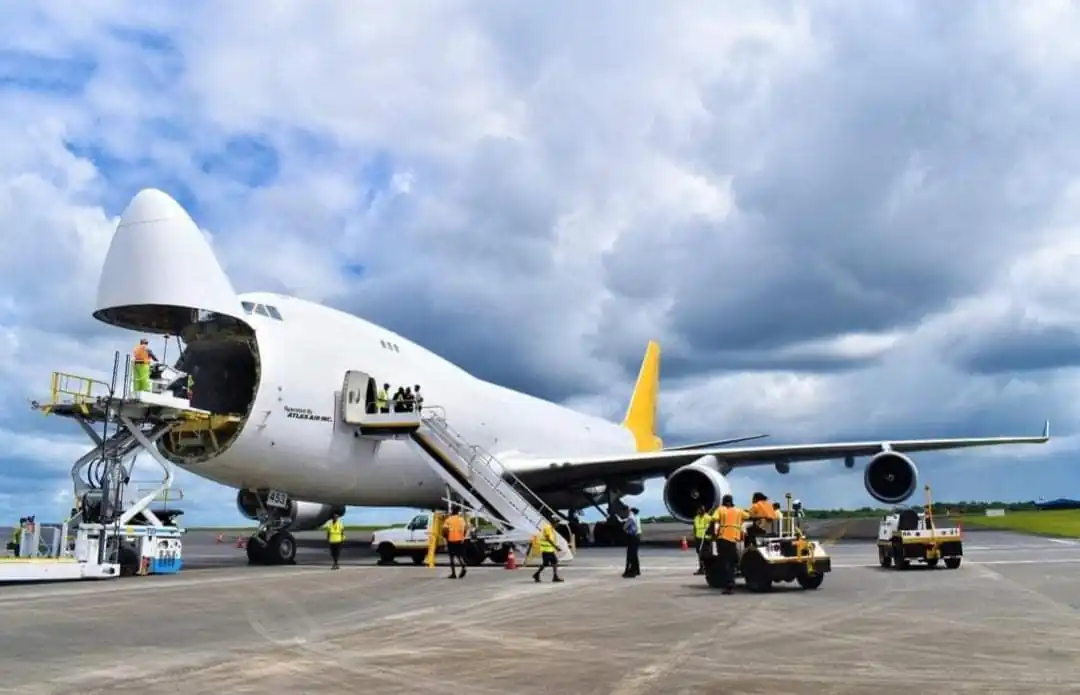
Guyana’s rapid economic expansion is changing not only what the country produces and imports, but also how it connects with the rest of the world. As trade volumes rise and businesses demand faster, more reliable supply chains, air cargo is becoming an increasingly important part of the country’s transport network. The question is no longer simply whether Guyana can accommodate more freight, but whether it can develop into a logistics gateway linking the Caribbean, South America and major international markets.
The growth in air freight is already significant. International air cargo volumes increased from approximately 7.66 million kilograms in 2020 to 14.43 million kilograms in 2025, representing an increase of about 88.5 per cent. The expansion has been driven partly by industrial equipment and supplies supporting Guyana’s oil and gas sector, growing e-commerce activity and wider economic expansion. Government data also indicated that the upward movement continued into 2026.
New services are widening Guyana’s air-freight connections. In March 2026, Avianca Cargo began a weekly cargo service between Miami and Guyana using an Airbus A330-243F with approximately 65 tonnes of dedicated cargo capacity per flight. In June, Cargojet Airways, operating for DHL Express USA, introduced a weekly non-scheduled route connecting Miami, Caracas, Georgetown and Medellín.
Connectivity expanded further in August when Air Cargo Pack completed its first Bogotá–Georgetown cargo flight. The company is licensed to move cargo between Guyana and markets including Colombia, Panama, Mexico and Brazil and has identified fresh produce, perishables, agricultural products, oil and gas equipment and other time-sensitive shipments among its target cargo categories.
These developments matter because geography gives Guyana an unusual opportunity. It is both a Caribbean Community member and a South American country, sharing a border with Brazil while maintaining strong economic and institutional links with the Caribbean. A stronger logistics system could therefore allow Guyana to serve not only its domestic economy but potentially function as a transfer point for goods moving between northern South America, Caribbean markets and North America.
The Brazil connection is particularly important. Trade between Guyana and Brazil has expanded rapidly, with Brazil’s Ambassador to Guyana reporting in May 2026 that bilateral trade had grown from approximately US$58 million in 2020 to about US$1 billion. At the same time, Guyana and Brazil have been moving to formalise cross-border transportation, while continued development of the Linden–Lethem corridor is intended to strengthen the overland connection between Guyana’s coast and northern Brazil.
If reliable roads, airports and ports are developed as parts of the same network, Guyana could provide businesses in northern Brazil with an additional route towards Atlantic, Caribbean and North American markets.
Agriculture presents another major opportunity. CARICOM has repeatedly identified better regional air and sea transportation and logistics as essential to improving intra-regional trade and food security. Its regional food-security initiative, originally associated with the “25 by 2025” target, was expanded and extended to 2030.
Guyana is simultaneously investing in agricultural processing and storage. A regional food hub under development is expected to provide cleaning, sorting, packaging, labelling and temperature-controlled storage for agricultural produce. Efficient air freight could complement sea transport by moving higher-value, perishable and time-sensitive goods such as fresh fruits, vegetables, seafood and specialised agro-processed products to regional markets more quickly.
This is where air cargo has an advantage. It will never replace maritime transport for bulk commodities because air freight is considerably more expensive. Its value lies instead in speed, reliability and access for high-value or time-sensitive goods. For Guyanese exporters, reducing travel time can mean longer shelf life, lower spoilage and access to markets that may otherwise be difficult to serve.
However, increasing flights does not automatically create a logistics hub.
A successful gateway requires an entire cargo ecosystem. Guyana will need sufficient warehousing, refrigerated storage, modern cargo-handling facilities, efficient customs and inspection systems, freight-forwarding capacity and dependable digital cargo tracking. Exporters must also consistently satisfy phytosanitary, packaging, security and product-quality standards in destination markets.
Cargo balance is another challenge. Air-freight routes become more commercially sustainable when aircraft can carry valuable cargo in both directions. Guyana’s current demand for imported machinery, equipment, consumer goods and industrial supplies can attract inbound capacity, but operators also need consistent outbound volumes. Developing competitive exports in agriculture, fisheries, manufacturing and other non-oil sectors would reduce the possibility of aircraft leaving Guyana with underutilised space and could help improve freight economics over time.
Infrastructure will therefore be central. Cheddi Jagan International Airport is undergoing additional development, including a planned 150,000-square-foot Terminal 2 expected to be completed in 2028, alongside proposed runway and taxiway improvements. Yet passenger facilities alone will not determine Guyana’s success as a freight hub. Dedicated investment in cargo terminals, cold-chain facilities, customs technology and connections among airports, farms, industrial zones, warehouses and seaports will be equally important.
Guyana must also recognise that it is entering a competitive space. Established logistics centres such as Miami and Panama already possess deeper cargo networks, significant freight volumes and mature distribution systems. Guyana’s opportunity does not necessarily lie in replacing those hubs. It can instead develop a specialised regional role: linking emerging production in Guyana and northern Brazil with Caribbean markets, supporting fast movement of energy-sector equipment and perishables, and functioning as a multimodal connection between road, air and sea transport.
So, can Guyana become a logistics gateway?
The answer is yes, but the transformation is still in progress. Rapid cargo growth, new airline services, stronger Latin American connections, airport investment and expanding regional trade provide a credible foundation. The next stage will depend on whether Guyana can turn these separate developments into an integrated logistics network that is efficient, reliable and commercially competitive.
If it succeeds, air cargo could become more than a supporting service for Guyana’s growing economy. It could become one of the mechanisms through which Guyana connects South America, the Caribbean and the wider world.