
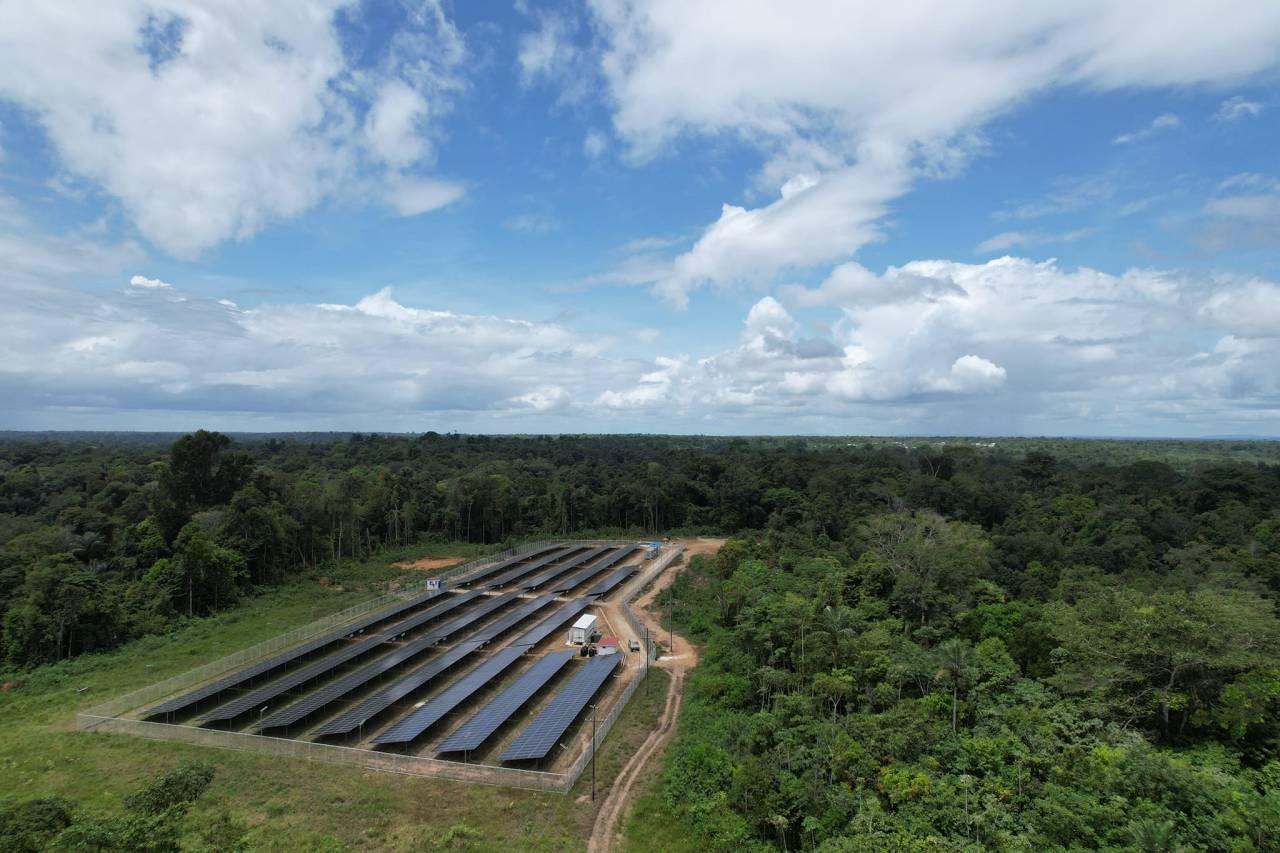
For many remote communities in Guyana, electricity is not simply a matter of convenience. It determines whether children can study after sunset, health facilities can preserve vaccines, businesses can operate efficiently and residents can remain connected to the wider country.
Yet extending conventional transmission lines across Guyana’s vast forested interior, rivers and difficult terrain is neither straightforward nor always economically practical. Many hinterland settlements are separated from major population centres by long distances and can be reached only by river, aircraft or unpaved roads.
This geography makes decentralised energy-electricity generated close to where it is consumed, one of the most important tools available for closing Guyana’s energy-access gap.
Beyond the National Grid
Guyana’s Low Carbon Development Strategy 2030 identified approximately 218 hinterland communities, with a combined population of about 98,500 people, that were located outside the country’s public electricity grids when the strategy was prepared. It also noted that diesel transported to off-grid villages could cost as much as three times the price paid in Georgetown.
Under these conditions, reproducing the coastal electricity model in every hinterland location may not be the most efficient solution. Decentralised systems; including solar home systems, community mini-grids, batteries and small hydropower facilities, can instead provide electricity without waiting for the national grid to reach each settlement.
These technologies can also be designed around the size, resources and energy needs of individual communities. A small household system may provide lighting, ventilation and device charging, while a larger solar-battery mini-grid can power schools, health centres, administrative offices and productive equipment.
Progress Is Already Visible
Guyana has begun implementing decentralised energy at considerable scale.
The Government launched its 30,000 Solar Photovoltaic Home Energy Systems project in July 2023 for hinterland and riverine households that were not connected to the grid. Each system was designed to operate two nine-watt LED lamps, a 12-watt fan and a USB charging port. According to the Guyana Energy Agency, the programme and its expansion had benefited 37,230 households by June 2025, reaching more than 136,000 people across over 245 communities and adding approximately 4.8 megawatts of installed capacity.
Although these individual systems provide relatively modest amounts of electricity, their social value can be substantial. Reliable lighting allows students to complete assignments at night, residents to charge phones and families to reduce their dependence on kerosene lamps or small generators.
Larger systems are also being developed. In April 2026, the government reported that 11 solar photovoltaic mini-grids in Regions One, Two, Six and Nine were being upgraded. The project was expected to increase their combined solar capacity from 108.8 kilowatts peak to 528.8 kilowatts peak, benefit more than 12,000 residents and provide 24-hour electricity to 116 public facilities.
In a separate 2026 initiative, solar photovoltaic systems were planned for 32 public buildings across Regions One, Two, Eight and Nine. The installations, with a combined generating capacity of 75.9 kilowatts peak and 235.52 kilowatt-hours of battery storage, were intended to serve health posts, schools, multipurpose buildings, school kitchens, guest houses and airstrip waiting areas. The Guyana Energy Agency also indicated that it would maintain the systems after installation.
Electricity as Development Infrastructure
The real importance of decentralised energy lies not only in the number of solar panels installed, but in what communities can do once dependable electricity becomes available.
For healthcare providers, electricity can support lighting, refrigeration, communication equipment and the safe storage of medicines. In schools, it can power computers, internet equipment and educational technology. For village administrations, it can improve recordkeeping, communication and access to government services.
The economic possibilities are equally significant. Reliable energy can support refrigeration for fish, meat and agricultural produce; water pumping and irrigation; cassava and agro-processing equipment; carpentry workshops; tourism facilities; digital services and small retail operations.
This is where hinterland electrification must move beyond basic household access. Lighting is an essential first step, but transformational energy access requires sufficient power for productive activity.
For energy planners, this means assessing not only current electricity demand, but also the demand that could emerge after reliable power is introduced. A mini-grid designed solely around existing consumption may quickly become inadequate once businesses begin purchasing freezers, pumps, machinery and other equipment.
The Importance of Hybrid Systems
Solar energy is particularly suited to Guyana’s remote communities because it can be installed in modular systems without requiring long transmission lines. However, solar generation is intermittent. Battery storage is therefore critical for supplying electricity after sunset and maintaining service during periods of reduced sunlight.
In some locations, solar can also be combined with hydropower or existing diesel generators. At Moco Moco in Region Nine, a 0.7-megawatt hydropower facility operates alongside solar generation and diesel backup. Other small hydropower developments identified by the Guyana Energy Agency include a 1.5-megawatt project at Kumu and a 0.15-megawatt facility at Kato.
Hybrid systems can improve reliability by using complementary energy sources while retaining diesel generation as a limited backup rather than the primary source of electricity.
Installation Is Only the Beginning
The success of decentralised energy will ultimately depend on what happens after systems are commissioned.
Remote locations create challenges for maintenance, replacement parts, technical supervision and battery disposal. A damaged inverter or depleted battery can leave a facility without electricity for weeks if spare parts and trained technicians are available only on the coast.
Long-term planning must therefore include community-level training, clear ownership structures, preventive maintenance schedules, remote system monitoring and properly funded replacement cycles. Equipment should also be selected for Guyana’s heat, humidity, rainfall and transportation conditions not simply because it has the lowest initial purchase price.
Community participation is equally important. Village leaders and residents should be involved in determining priority loads, operating hours, expansion plans and payment arrangements where tariffs are required. A technically sound system can still fail if its governance model is unclear or if the community does not have the capacity to manage it.
Powering Opportunity
Decentralised energy gives Guyana an opportunity to approach hinterland electrification differently. Instead of treating remote communities as the final destinations of an expanding coastal grid, policymakers can build locally appropriate energy systems around solar, batteries, small hydropower and carefully managed backup generation.
The next phase should focus on moving from basic access to reliable, productive and scalable electricity. That will require stronger maintenance systems, local technical capacity, data-driven demand planning and closer links between energy investments and agriculture, healthcare, education, tourism and digital connectivity.
When electricity is planned as development infrastructure rather than simply installed as equipment, decentralised energy can do more than illuminate homes. It can strengthen essential services, unlock enterprise and give remote communities a greater role in Guyana’s economic transformation.