
Guyana’s transformation is creating new opportunities across energy, construction, infrastructure, agriculture, manufacturing, hospitality, technology and other industries. But physical infrastructure and investment alone cannot sustain that transformation. The country also needs people with the practical and technical skills required to build, operate, maintain and support an increasingly sophisticated economy.
This is where Technical and Vocational Education and Training (TVET) is becoming increasingly important.
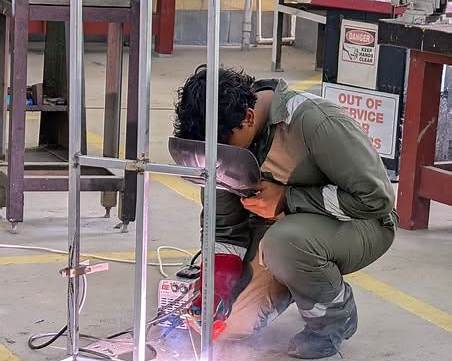
TVET provides a pathway through which individuals can acquire occupational and technical competencies that translate directly into the workplace. Electricians, welders, mechanics, instrumentation technicians, plant operators, safety professionals, construction workers and other skilled personnel are essential to modern industry. As Guyana’s economy develops, strengthening this segment of the workforce is becoming an important part of ensuring that Guyanese can participate meaningfully in the opportunities being created.
The Government of Guyana formalised this direction with the launch of the National TVET Policy 2025-2035 in April 2025. Developed with support from the World Bank following a review of the sector, the policy seeks to strengthen workforce development and improve the alignment between technical education and labour-market needs. It identifies areas including oil and gas, climate-resilient agriculture, low-carbon technologies and digital development as important components of Guyana’s changing economic landscape.
Expanding Access to Practical Skills
Investment in facilities and training is accompanying this policy direction.
According to the Ministry of Education, G$2.5 billion was allocated in Budget 2026 to expand access to TVET, while approximately G$450 million was invested in tools and equipment in 2025. The Ministry also reported more than 500 teachers trained, 144 TVET institutions nationwide and 78 schools approved to offer Caribbean Vocational Qualifications (CVQs) as of early 2026.
The expansion is also becoming more geographically inclusive.
Practical instructional spaces have been commissioned in communities including Bartica, St. Ignatius, the North West District, Beterverwagting, Fellowship and Hopetown. Budget 2026 states that these investments benefited more than 3,900 persons over the preceding five years. A practical instructional centre at Mahdia was also budgeted for construction in 2026.
In September 2026, Minister of Education Sonia Parag announced the Government’s intention to have a TVET centre established in every region of Guyana by the end of 2026, reflecting an effort to make skills training accessible beyond the major population centres.
Such access matters. Guyana’s development is occurring throughout the country, and communities outside Georgetown will increasingly require qualified people capable of supporting construction, agriculture, utilities, transportation, tourism, energy and other forms of economic activity.
Preparing Guyanese for Emerging Industries
The connection between technical education and the energy industry is particularly significant.
The Guyana Technical Training College (GTTC) at Port Mourant, completed in 2025, was established to provide practical training relevant to the oil and gas sector. Budget 2026 reported that more than 50 persons had already graduated through training using the college’s Facility Simulator in areas including mechanical, production and process operations, with another 20 expected to graduate in March 2026.
But Guyana’s skills agenda must extend beyond oil and gas.
Large-scale development creates demand throughout interconnected industries. A new industrial facility, housing project, highway, hotel, farm, power project or manufacturing operation requires more than engineers and managers. It depends on technicians, equipment operators, electricians, mechanics, welders, safety personnel and numerous other skilled workers.
Consequently, strengthening TVET can help Guyana develop the wider workforce required to support economic diversification.
Recent developments are also broadening the level and sophistication of available training. In September 2026, an Occupational Safety and Health Centre of Excellence was commissioned at the New Amsterdam Technical Institute. The facility is expected to host the Level Three Caribbean Vocational Qualification in Occupational Safety and Health and operate as both a national and regional training hub.
Building Skills That Match Industry
Expanding the number of training institutions, however, is only part of the equation.
The effectiveness of TVET ultimately depends on how closely training corresponds with the skills employers actually require. Strong relationships among training institutions, government and industry can help ensure curricula remain relevant as technologies, occupational standards and business practices evolve.
This is especially important in sectors where safety requirements, specialised equipment and international standards influence employment.
Qualifications such as the CVQ can also support greater standardisation and recognition of technical competencies within the Caribbean. At the Mahaicony Technical and Vocational Training Centre, for example, a new block commissioned in April 2026 increased the institution’s capacity from just over 300 students to more than 500 as part of continuing efforts to expand skills-based education and certification.
Industry itself also has a role to play. Apprenticeships, internships, work placements, equipment support, curriculum input and partnerships with training institutions can help close the distance between the classroom and the workplace.
Changing the Perception of Technical Careers
Guyana’s transformation also requires a cultural shift in how technical careers are viewed.
For generations, conventional academic education has often been regarded as the principal pathway to professional success. Yet modern economies depend equally on highly skilled technical workers. Technical education should therefore be understood not as an alternative of lesser value, but as another route to specialised knowledge, entrepreneurship, stable employment and professional advancement.
That message becomes increasingly important as industries compete for workers with specialised competencies.
For young Guyanese deciding on careers, TVET can provide pathways into industries that are expanding around them. For adults already in the workforce, continuing technical education can provide opportunities to upgrade existing skills or transition into new occupations.
Ultimately, the success of Guyana’s economic transformation will not be measured only by the infrastructure constructed or the investments attracted. It will also be reflected in how effectively Guyanese people acquire the skills needed to participate in, manage and sustain that growth.
The foundations of a modern economy are built not only with capital, technology and natural resources, but with capable people.
As Guyana moves through a period of exceptional economic and industrial change, strengthening technical and vocational education offers an opportunity to ensure that its greatest resource (its people) remains at the centre of that transformation.