As Guyana’s economy expands, so too does the challenge of managing the waste generated by households, businesses, construction activity and a growing range of industries. Traditionally, waste has been treated as something to collect, transport and dispose of. The circular economy offers a different approach: keeping materials in productive use for as long as possible through reducing waste, reusing products, repairing materials, recycling and recovering value from resources that would otherwise be discarded.
For Guyana, that shift could create more than a cleaner environment. It could open new areas for entrepreneurship, investment, employment and innovation.
The concept is already reflected in national policy. Guyana’s Low Carbon Development Strategy (LCDS) 2030 outlines plans to develop a circular economy framework that includes a national recycling system, measures to minimise certain sources of pollution, incentives for better product design and greater access to segregated waste services for households, businesses and public institutions. The strategy also envisages stronger public education around recycling and waste prevention.
The direction is increasingly visible in the country’s waste-management programme. Budget 2026 provides $7.9 billion for a comprehensive approach to solid waste management, including upgraded landfill infrastructure, additional waste-management equipment and continuation of a waste recycling and separation initiative. Importantly for the private sector, the Government has also said it will evaluate proposals from private investors for waste-to-energy pilot projects.
These developments create an important question: what if more of Guyana’s waste could become an economic input rather than simply an environmental burden?
From Disposal to Value Creation
A circular economy begins by looking at discarded materials differently.
Plastic, cardboard, metals, glass, organic waste and some construction materials can potentially retain economic value after their first use. Capturing that value requires systems for separation, collection, processing and, importantly, markets for the recovered material.
This creates opportunities throughout the value chain.
Businesses could provide specialised collection and sorting services to commercial customers. Entrepreneurs could develop recycling and upcycling operations. Organic waste from markets, restaurants, agriculture and food-processing operations could support composting and other forms of organic-waste recovery where technically and commercially feasible. Reusable packaging, repair services and products manufactured from recovered materials could develop into additional areas of enterprise.
The objective is not simply to create more recycling companies. It is to redesign economic activity so that less material becomes waste in the first place.
For businesses, this could mean finding ways to reduce packaging, reuse materials, repair equipment instead of immediately replacing it, establish take-back systems or identify another company capable of using a by-product that would otherwise be discarded.
Opportunities Are Already Emerging
Guyana has already seen smaller-scale examples of circular-economy activity.
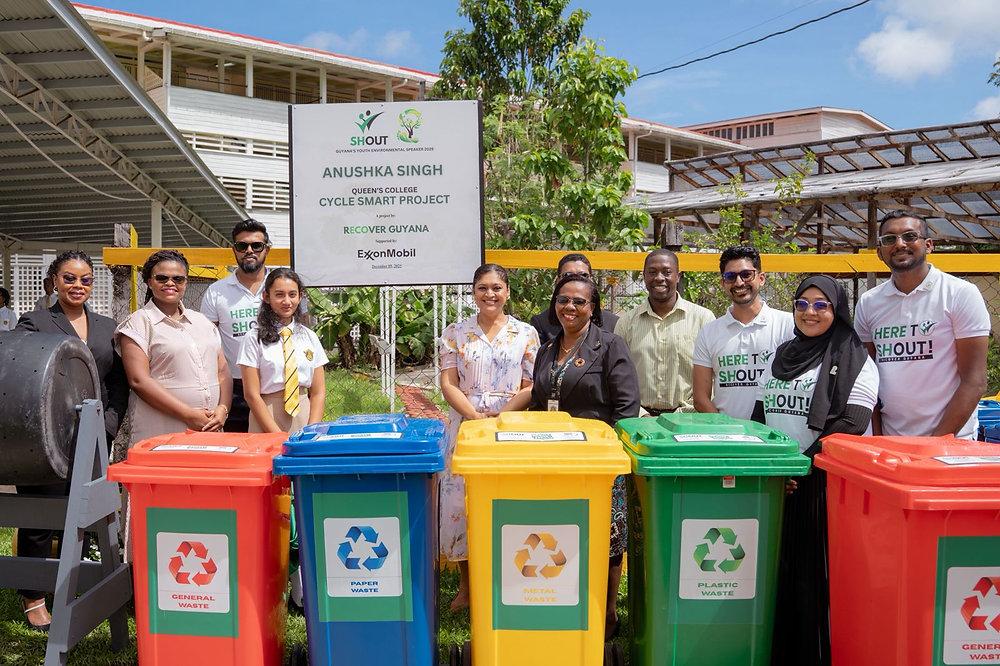
A UNDP-supported project implemented in East Berbice, for example, focused on recycling and upcycling plastic waste while training young people in plastic-waste management and the operation of recycling machinery. The project was designed not only to address improperly discarded plastic but also to improve participants’ opportunities to generate income.
Another GEF Small Grants Programme initiative has been working with secondary schools in Region Three to encourage plastic collection, recycling and circular-economy practices.
These initiatives are relatively small compared with the scale of Guyana’s national waste challenge, but they demonstrate an important principle: discarded material can become a resource around which skills, businesses and community enterprises are developed.
That approach is becoming increasingly relevant at the national level.
In June 2026, the Government, through the Ministry of Local Government and Regional Development, launched the development of a new National Solid Waste Management Strategic Plan with technical support from UNDP and financing through the Partnership for Action on Green Economy. According to UNDP, the process is intended to help Guyana move towards systems that give greater priority to resource efficiency, recycling, recovery and sustainable consumption, while creating opportunities for investment and green economic activity.
A Role for the Private Sector
Government infrastructure alone cannot create a functioning circular economy.
Businesses will have an important role in building markets for recovered materials and developing commercially viable solutions.
Potential areas include recycling and material recovery, commercial waste collection, composting, sustainable packaging, repair and refurbishment, reusable products, environmental consulting, waste auditing and technologies that help organisations monitor and reduce the waste they generate.
Growing attention is also being placed on producer responsibility. In May 2025, Guyana hosted discussions and capacity-building activities on Extended Producer Responsibility and the circular economy through the PROMAR project. Extended Producer Responsibility, commonly known as EPR, is an approach under which producers can be assigned greater responsibility for products and packaging after consumers have finished using them.
For Guyanese businesses, developments such as these point to a future in which environmental performance may increasingly influence how products are designed, packaged, distributed and eventually recovered.
There are also opportunities for established companies to incorporate circular practices into their existing operations rather than treating waste management as a separate activity.
The Guyana Energy Agency’s inaugural Energy Champions Awards, launched in July 2026, for example, includes waste as one of its sustainability focus areas and specifically recognises waste reduction and circular systems based on reducing, reusing and recycling materials.
Building the System
The transition will not happen automatically.
A commercially successful recycling sector requires reliable supplies of separated materials, suitable collection infrastructure, processing capacity, clear regulation and customers willing to purchase recovered products.
Guyana is simultaneously working on these more fundamental elements of waste management.
The 2025 national budget allocated $13.2 billion to solid-waste management initiatives, including further development of the Haags Bosch Sanitary Landfill, new and upgraded landfill facilities, waste-management equipment, a planned recycling centre and a recycling and public-awareness programme.
In January 2026, a national consultation was also held on a proposed Integrated Solid Waste Management Bill. Among the areas identified were waste reduction, segregation, recycling and resource recovery. At that stage, the proposed legislation was still proceeding through Guyana’s review process and should therefore not be treated as enacted law unless and until Parliament approves it.
That distinction is important. Guyana is building the policy and physical foundations for a more circular system, but several components remain under development.
Waste as an Economic Resource
The larger opportunity is ultimately about changing how value is understood.
When recyclable plastic reaches a landfill, potential material value is lost. When usable equipment is discarded rather than repaired, additional resources are required to replace it. When organic material that could potentially be recovered is mixed with general waste, another possible economic input disappears.
A circular economy attempts to capture more of that value.
For Guyana, the opportunity is particularly significant because economic expansion provides the country with a chance to incorporate better waste-management practices while new industries, communities and infrastructure are still being developed.
The goal should not simply be to manage a growing volume of waste more efficiently. It should also be to prevent unnecessary waste, recover valuable materials and create markets in which resources circulate through the economy for longer.
If the right infrastructure, regulations, investment incentives and markets develop together, waste management can become more than a public-service challenge. It can support a new generation of Guyanese businesses built around recycling, recovery, repair, reuse and resource efficiency.
In that model, what was once considered the end of a product’s life becomes the beginning of another economic opportunity.