
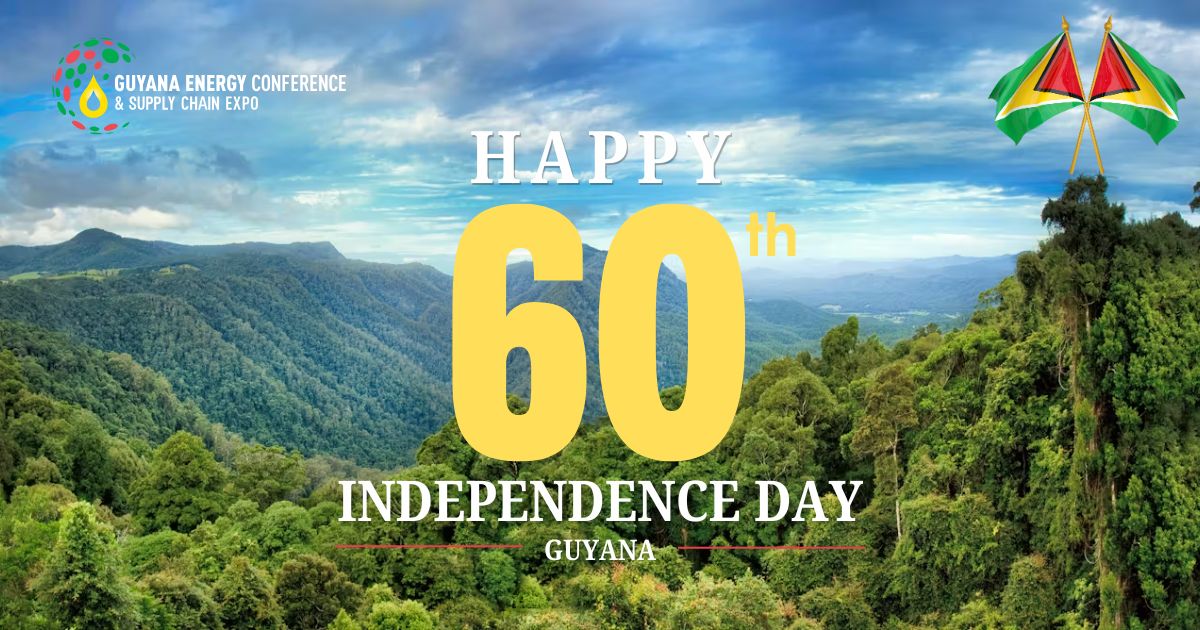
Sixty years ago, on May 26, 1966, a small nation on the northern shoulder of South America raised its Golden Arrowhead and stepped into independence. It was a moment of immense promise and immense uncertainty. The road ahead would not be easy. But the people of Guyana, shaped by centuries of struggle and survival, were not strangers to difficult roads. They had walked harder ones before.
As the nation marks its 60th anniversary, the story of Guyana is one that deserves to be told in full not only as a record of where this country has been, but as a testament to where it is now standing and where it is boldly headed. It is a story of resilience, of cultural richness, of environmental stewardship, and of a transformation so rapid and consequential that the world has taken notice.
Long before the world discovered Guyana’s oil, the country’s greatest wealth was already visible to those paying attention in its people. Known as the “Land of Many Waters,” Guyana has always drawn its identity from the confluence of its six peoples: Indigenous, African, Indian, European, Portuguese, and Chinese. Each community arrived by a different path, under vastly different circumstances, and each left an indelible mark on the nation’s character.
The result is a cultural tapestry unlike anything else in the world. Guyanese cuisine, music, faith, and festivals reflect a living conversation between traditions that have coexisted, blended, and shaped one another across generations. Whether through the rhythms of chutney and soca, the aromas of curry and pepper pot, the ceremonies of Diwali and Phagwah, or the oral histories carried down through Indigenous communities, Guyana’s culture is not a relic it is vibrantly alive.
That identity, plural, dynamic, and deeply rooted, remains the foundation upon which everything else is built. As Guyana accelerates into a new era of development, the voices calling loudest for the preservation of culture and community are often the same voices most invested in the country’s future. For many Guyanese, prosperity means little if it comes at the cost of who they are.
Independence did not bring immediate stability. The decades following 1966 were marked by economic hardship, political turbulence, and significant emigration as Guyanese sought better lives abroad. At times, the country felt as though it were in retreat, its most talented citizens leaving, its institutions under strain, its potential unrealised.
Yet through every period of difficulty, something endured. Communities held together. Families persisted. A quiet, determined pride in Guyanese identity never fully extinguished, even among those who left. The Guyanese diaspora, spread across the Caribbean, North America, and beyond, carried their culture with them and never entirely let go of home.
That diaspora is now watching the transformation of their homeland with a mixture of astonishment and deep personal pride. The Guyana they grew up in, or that their parents described, is changing at a pace that would have seemed impossible just fifteen years ago.
Even as Guyana faced its hardest years, it quietly held onto something the rest of the world was only beginning to understand the value of. The country’s vast interior, its ancient rainforests, winding rivers, sprawling savannahs, and the thunderous spectacle of Kaieteur Falls, was being protected long before “sustainability” became a corporate buzzword.
Guyana remains one of the most biodiverse nations on Earth, home to species found nowhere else, and one of the few countries whose forests still stand largely intact. Those forests represent one of the planet’s most critical carbon sinks, a natural buffer against the worst consequences of climate change. In an era when the world is urgently seeking solutions to the climate crisis, Guyana’s environmental inheritance is not merely a natural asset. It is a global one.
This places Guyana in a position that very few nations in the world occupy: simultaneously a significant and growing energy producer, and a guardian of one of the last great intact wilderness regions on earth. The tension between those two roles is real, and Guyana is navigating it with greater seriousness and ambition than many observers expected.
In 2015, ExxonMobil announced a significant offshore oil discovery in Guyana’s Stabroek Block, a find that would prove, in the years that followed, to be not an outlier but a prologue. More than 30 major discoveries later, the Stabroek Block alone is estimated to hold recoverable resources of nearly 11 billion barrels of oil equivalent, placing Guyana among the most consequential upstream developments of the 21st century.
When first oil production began in December 2019, Guyana officially joined the ranks of the world’s oil-producing nations. What happened next was remarkable even by the accelerated standards of frontier energy development. Production scaled rapidly, past 300,000 barrels per day, then past 600,000, surpassing 900,000 barrels per day with the startup of a fourth major floating production facility in 2025. The pace of development has been described by industry analysts as among the most impressive in deepwater history.
The economic consequences have been profound. Guyana has consistently ranked among the world’s fastest-growing economies in recent years. Revenues flowing into the national treasury are funding an infrastructure transformation visible from Georgetown to the most remote corners of the country, new roads, bridges, hospitals, schools, housing, and technology projects are reshaping daily life for hundreds of thousands of Guyanese.
Perhaps what is most striking about Guyana’s emergence is that the country has not simply become a subject of global interest, it has claimed a place in shaping global conversations. In international forums on energy security, climate finance, the just transition, and sustainable development, Guyana’s voice is increasingly present and increasingly influential.
The Guyana Energy Conference & Supply Chain Expo has itself become a significant fixture in that conversation, a platform where regional and international stakeholders gather to engage seriously with the opportunities and responsibilities that come with Guyana’s new position in the global energy landscape. The growth of the conference mirrors the growth of the country: rapid, substantive, and increasingly impossible to ignore.
For the young Guyanese coming of age in 2026, the country’s 60th Independence anniversary carries a weight that goes beyond ceremony. They are the first generation for whom a globally connected, economically dynamic Guyana is not an aspiration but a reality, imperfect, uneven in places, but undeniably real. The opportunities now visible to them, in entrepreneurship, technology, energy, environmental science, finance, and the arts were not available in the same way to their parents or grandparents.
Yet their elders are also clear about what must not be lost in the rush forward. The culture, the values, the unity across difference, the connection to the land, these are not decorative elements of the national story. They are its structural foundations. The challenge for this generation is not to choose between development and identity, but to insist, loudly and continuously, that both matter.
Six decades after independence, Guyana stands as a nation genuinely transformed. Not transformed beyond recognition, the spirit, the warmth, the complexity, and the stubborn pride that have always defined Guyanese people are as present as ever. But transformed in its standing, its reach, and its sense of what is possible.
From a country once overlooked on the margins of global attention to one now shaping conversations about energy, climate, and development, Guyana’s journey has been extraordinary. And if the pace and ambition of the last decade are any guide, the next chapter will be the most defining yet.
The true measure of success, as Guyanese have long understood, will not be counted in barrels or buildings alone, but in whether the prosperity rising from these waters reaches the hands and lives of every Guyanese, and whether the nation’s identity, environment, and values are carried forward intact for the generations still to come.